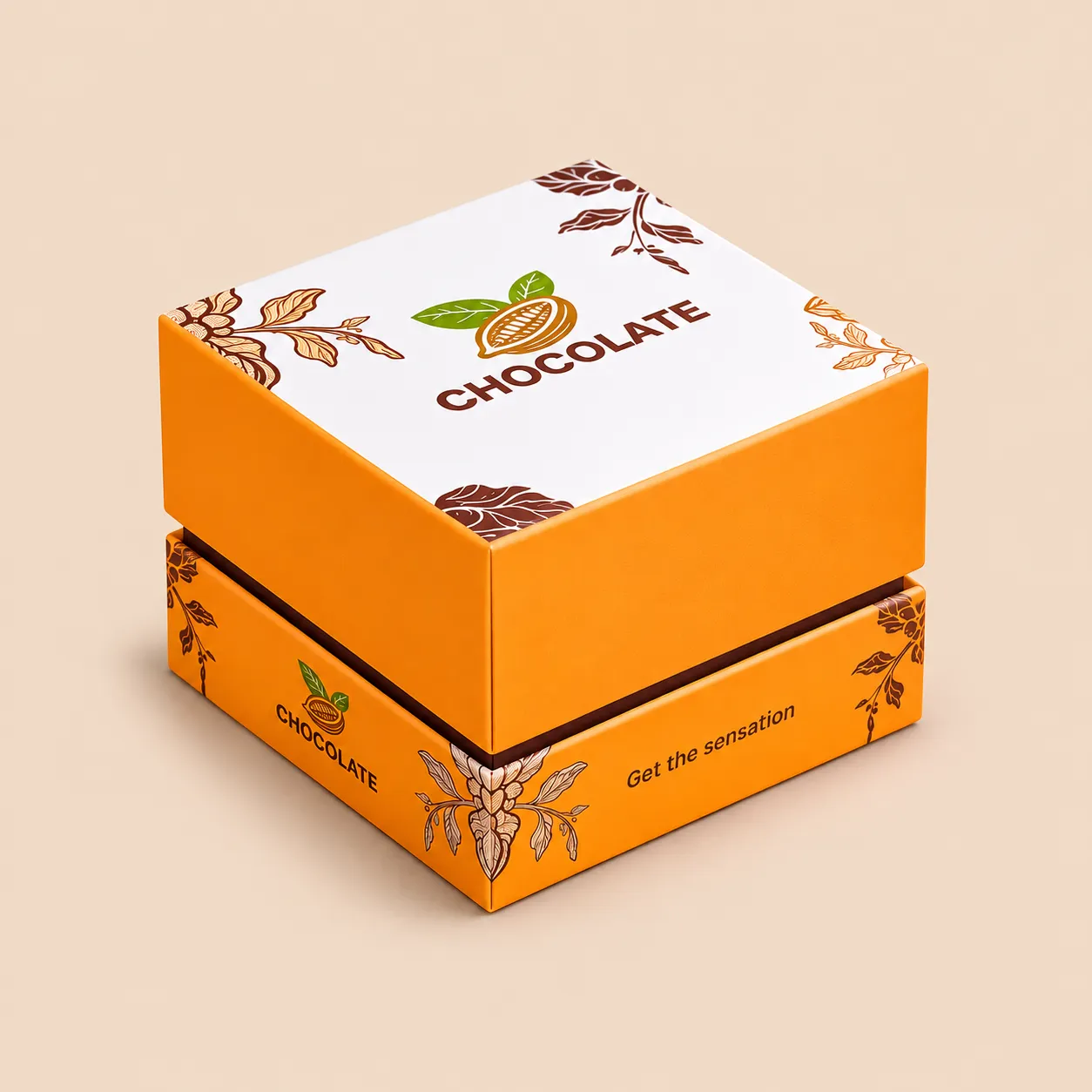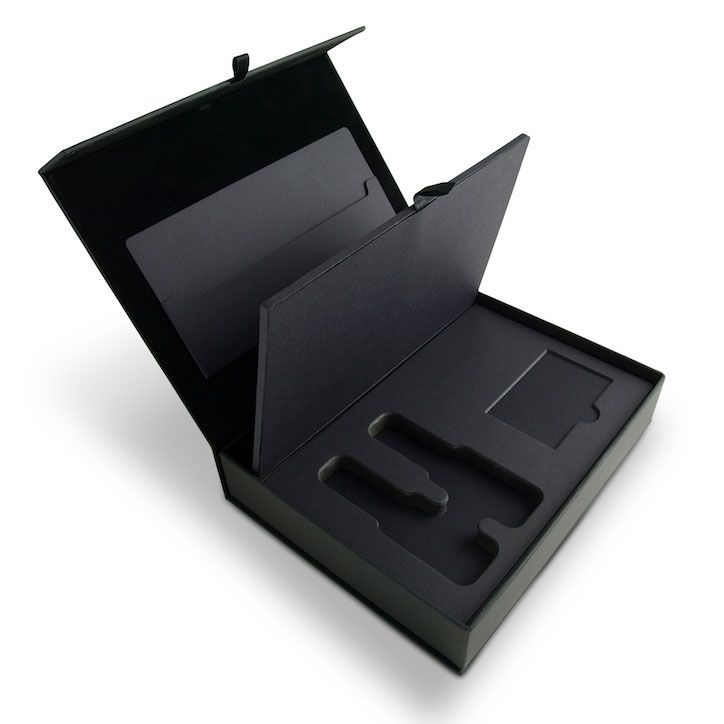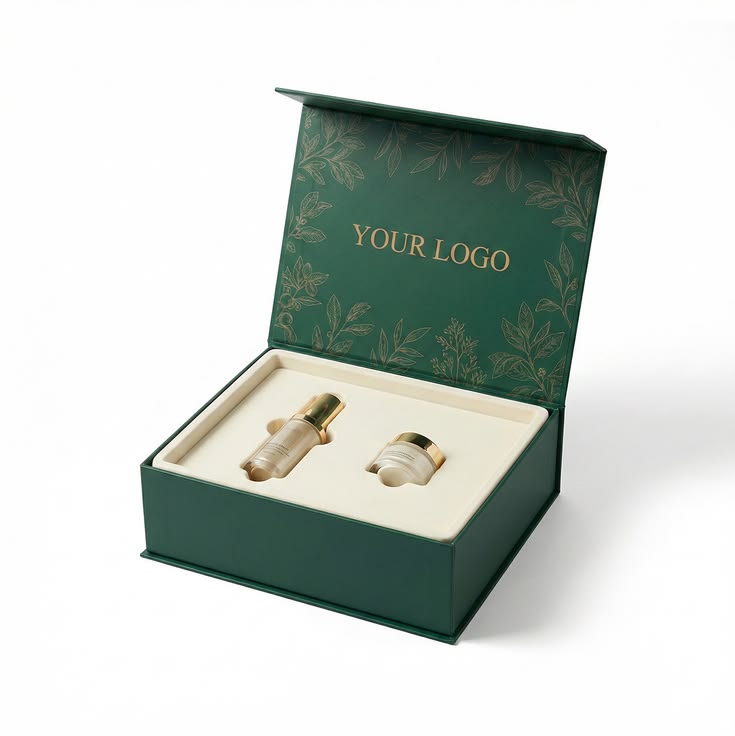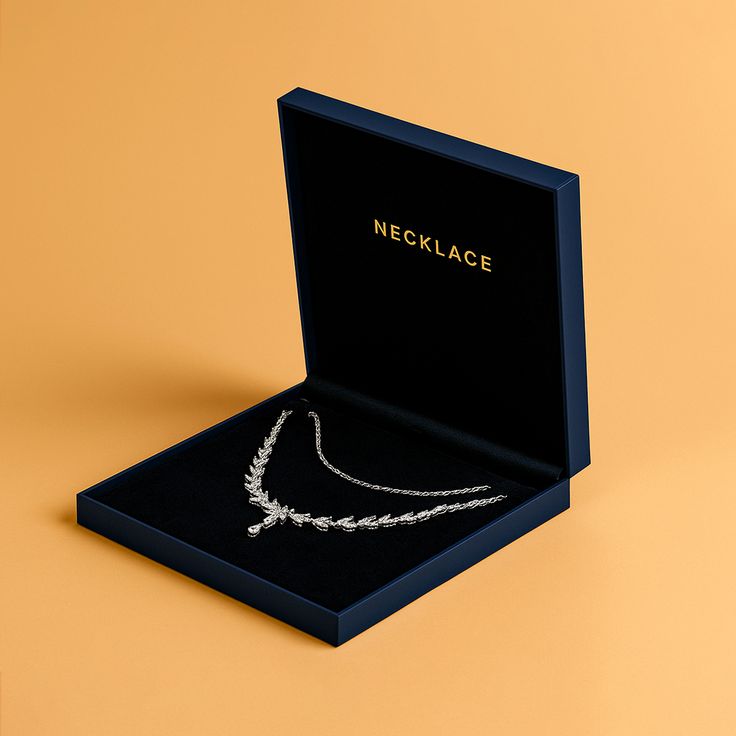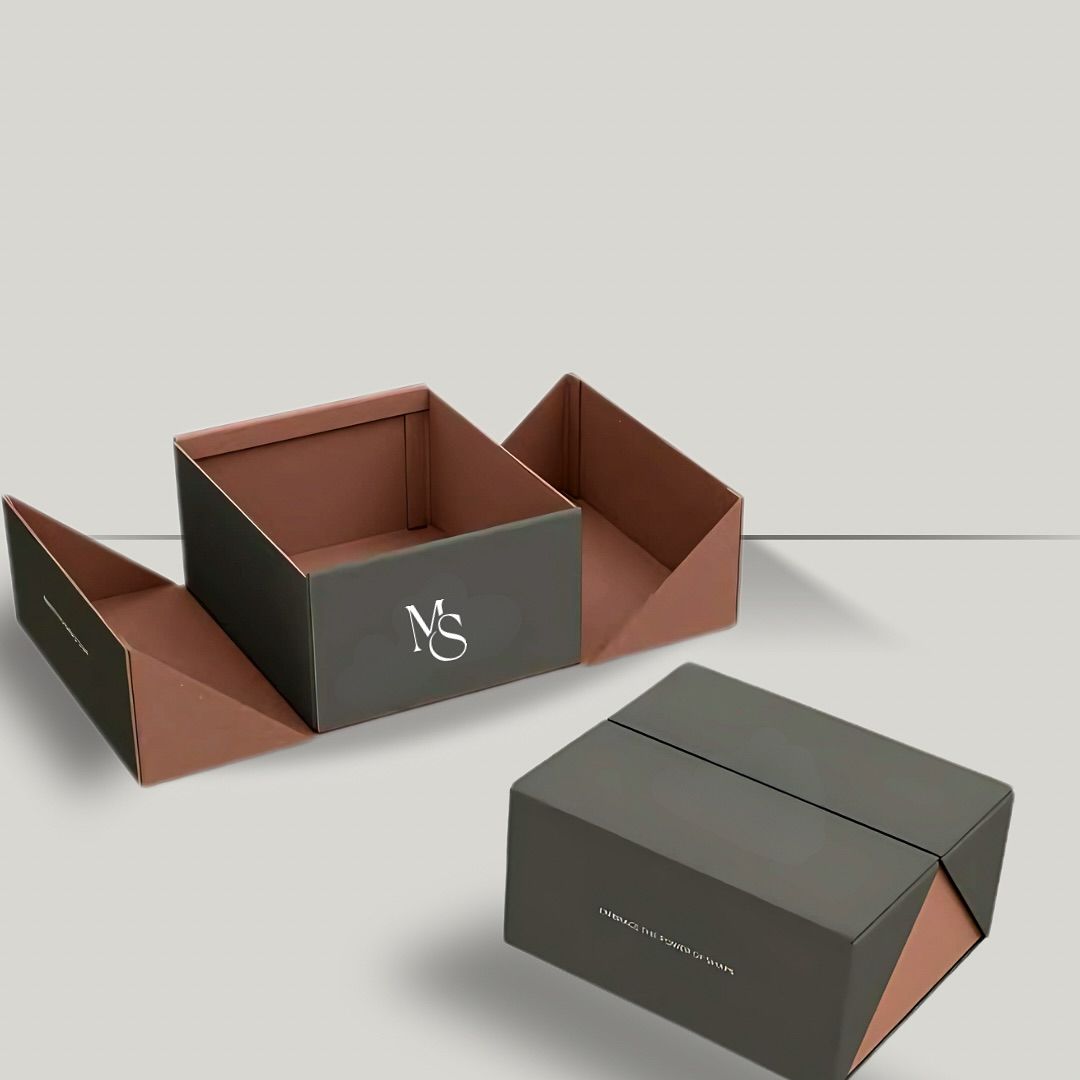


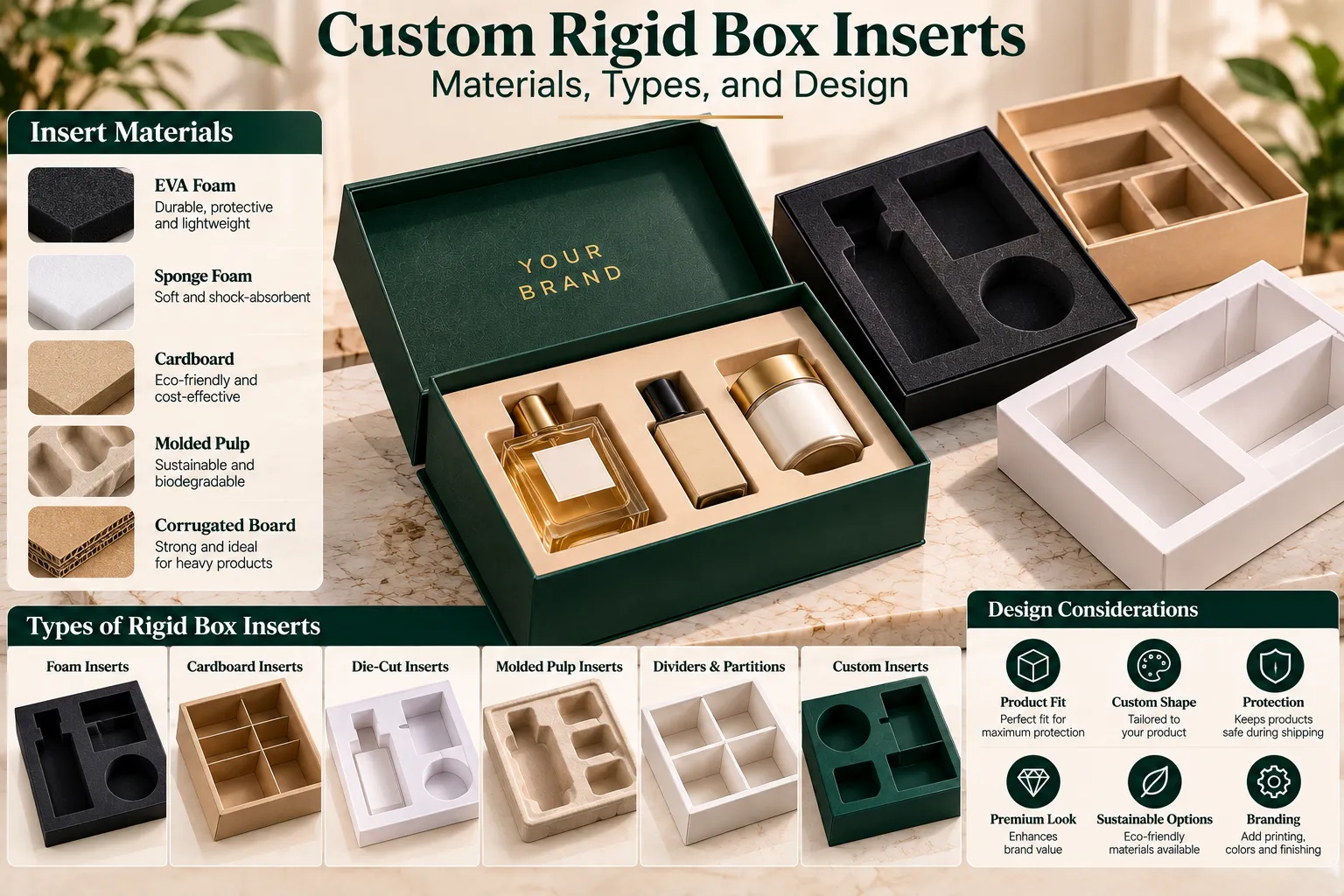








Custom rigid box inserts are the cut or molded components within a box that help keep each item in place. Choosing the right insert is based on three factors: material the product is made of, number of products per box, and how you wish your customer to see the product once the lid is opened. Here we will discuss the types of materials used for inserts, cavity sizes, and how to design an insert.
What Custom Rigid Box Inserts Do
A rigid box gives you a stiff outer shell. The insert takes care of all things inside it. It ensures that the product does not move around, distributes multiple products equally, and frames the product so that the first thing the customer notices is the product and not just an empty space.
Inserts help with the presentation too. A watch standing straight in a velvet-like cushion looks different than the same watch lying flat in a cardboard tray. Things like the depth of the cavity, finger notch, and platform affect how the box opens up and the way the product is extracted from the box. For more on designing this experience, refer to our luxury packaging unboxing ideas.
Insert Materials: Foam vs. Paperboard and More
Rigid box inserts usually come from two groups, namely foam inserts and paperboard inserts. Velvet inserts can be added to the group of presentation products. In case you are still selecting the rigid box, our blog post on rigid box material might come in handy.
Foam Inserts
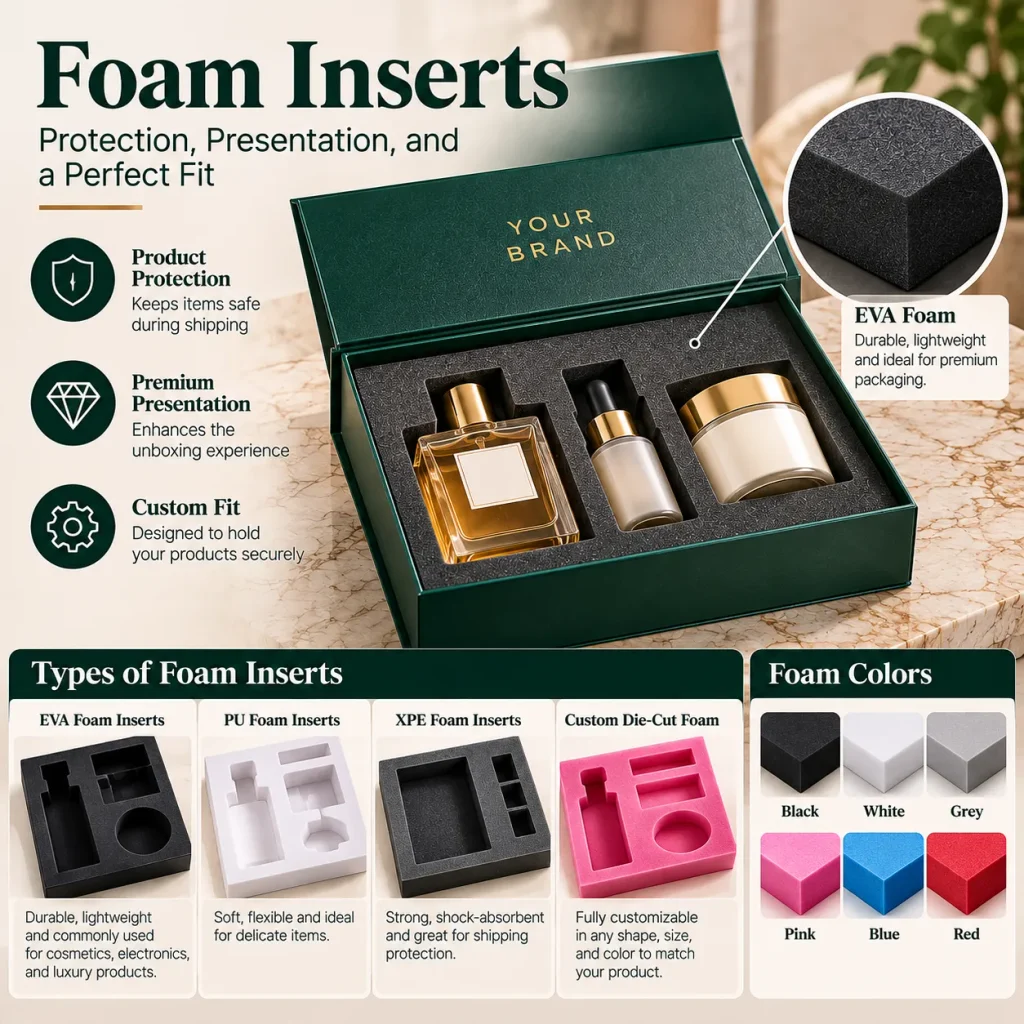
Foam inserts are created from a sheet of PE, PU, or EVA foams. Each type has unique characteristics:
- PE foam is firm, light weight and has a smooth closed cell surface.
- PU foam is soft and has an open cell structure, which allows compression against irregular shape.
- EVA foam is dense foam and has an even surface that will keep clean cut edges.
Foam material is ideal for products with irregular shapes, such as scented bottles with a sculpted cap or a tool set. Foam insert may also be covered with fabric or paper material. See examples of our rigid boxes with foam inserts.
Paperboard Inserts
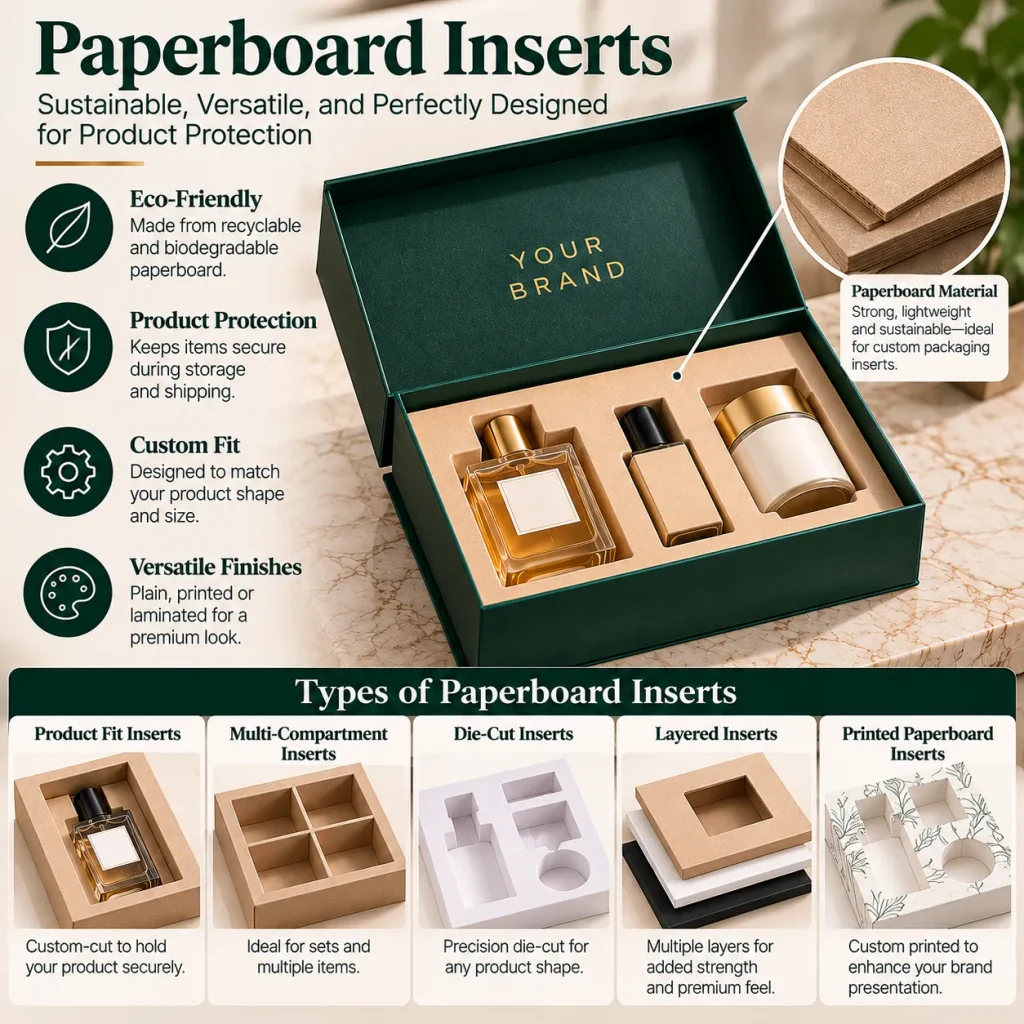
Paperboard inserts are constructed out of cardboard that is then cut, folded, and sometimes even wrapped in the same paper that covers the outside of the box. They are perfect for items that have consistent shapes, such as a cylindrical candle, a rectangular gadget, or a set of 50 ml dropper bottles.
Most companies use paperboard inserts because they complement the exterior of the box. The paper-covered insert can have its own color, print, or a little piece of foil to create an overall design.
Velvet-Style and Fabric-Covered Inserts
Velvet-style materials are often used for presenting jewelry, watches, and gifts. These are typically used on a foam or board base, giving you the form of the base with a soft, textured surface on top.
Comparing Insert Materials
| Material | Feel and look | Best suited to | Design notes |
|---|---|---|---|
| PE foam | Firm, light, smooth | Electronics accessories, tools, kits | Holds straight cavity walls well |
| PU foam | Soft, compressible | Irregular shapes, delicate items | Can be wrapped for a cleaner surface |
| EVA foam | Dense, fine surface | Bottles, devices, premium kits | Clean cut edges show well when left uncovered |
| Paperboard | Crisp, printable | Candles, jars, boxes within boxes | Can be wrapped to match the exterior |
| Velvet-style | Soft, textured | Jewelry, watches, gifts | Wrapped over a foam or board base |
Die-Cut Inserts, Cavities, and Product Fit
Die-cut inserts are made by cutting a foam or board to the exact form. This cut creates a cavity that is the same as the product’s form, ensuring that the product remains in place and does not roll around in a flat tray.
Good fitting of the product requires three dimensions: the length, width, and depth of the product at its largest points. If the cavity is too large, it allows the product to move around. If it is too small, it will be difficult to remove the product, and the printed label will get scratched.
Cavity depth is easy to overlook. A 30ml perfume bottle should look good when about half of its height fits into the cavity, and the cap remains fully in sight. The same applies to the lipstick tube that should look almost flush. Determine how much of the product should be visible before cutting the cavity. Our article on how to choose the right size of rigid box shows how important insert depth is for overall box size.
Matching Inserts to Box Style
Box type impacts how insert is made:
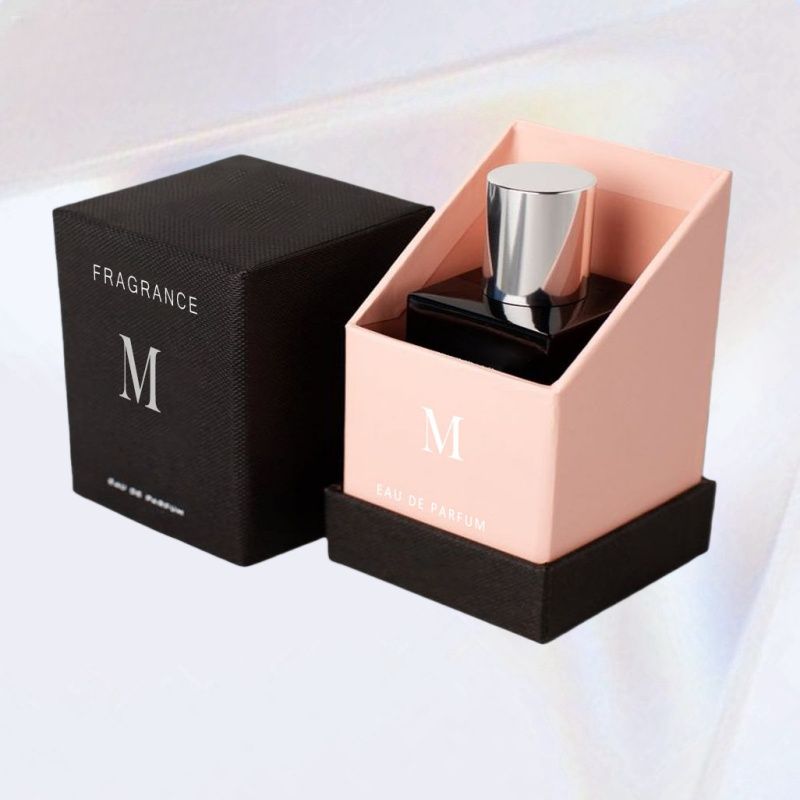
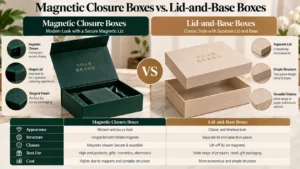
- In rigid magnetic closure boxes, the top part hinges open, and thus the insert should fit into the bottom part of the box in the angled position. A raised shelf or angled cavity helps put the product in the right view for the customer.
- In shoulder neck rigid boxes, there is already an inner neck that occupies a certain space; thus, the insert should fit inside this neck.
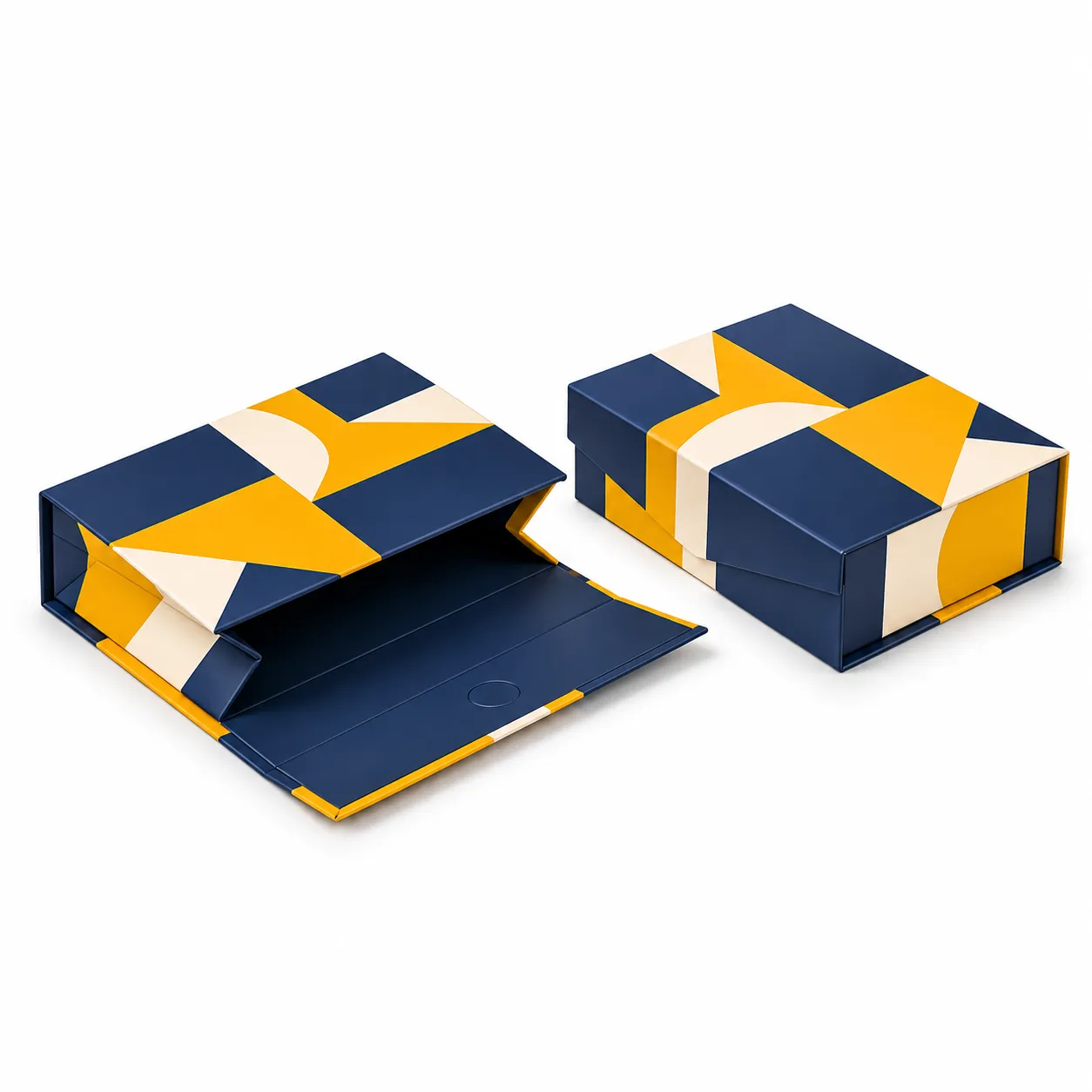
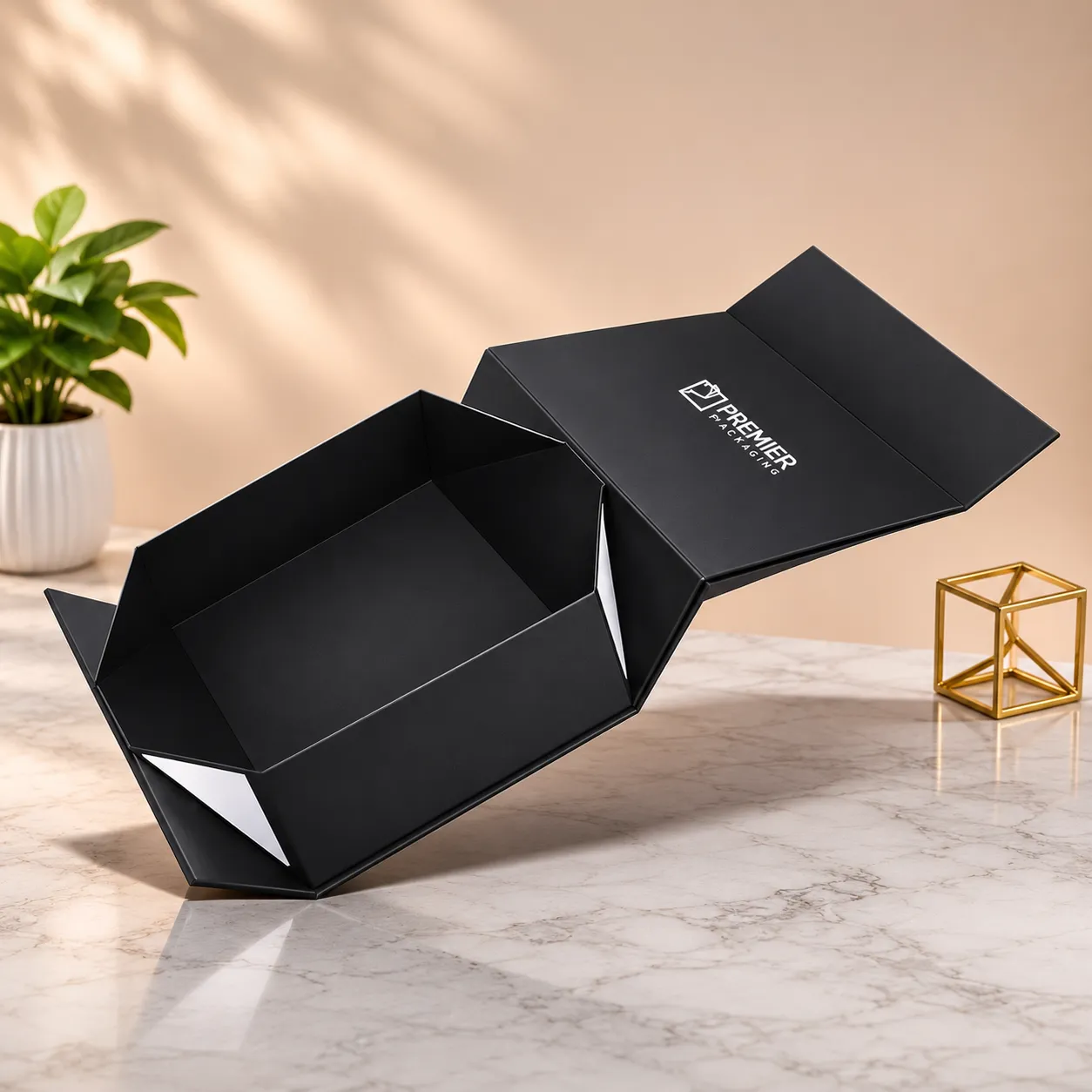
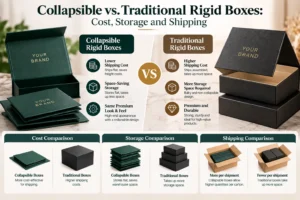
- For foldable rigid boxes, the box comes flat, meaning the inserts should always come separately and get dropped into the ready-to-use box.
Multi-Item Layouts
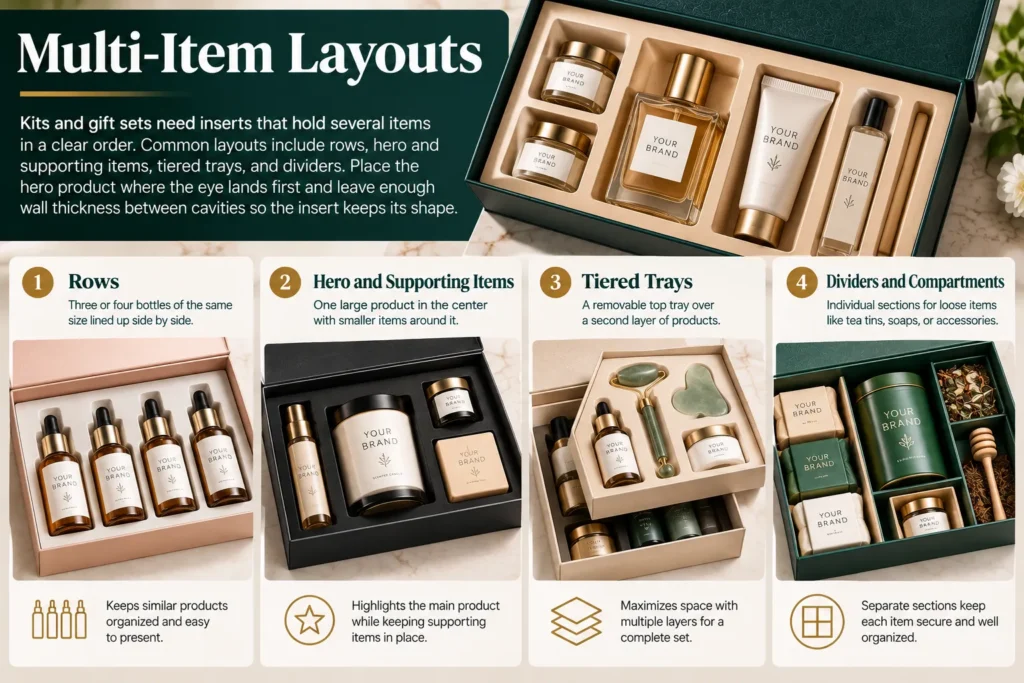
Kits and Gift Sets require inserts that would accommodate several items in proper sequence. Popular configurations include:
- Rows: three or four similar-size bottles in rows.
- Hero with supporting product: one large item in the middle flanked with smaller pieces.
- Tiered Trays: an additional upper tray on top of a layer of products.
- Compartments/Dividers: separate compartments for free-flowing items such as tea tins, soaps, or accessories.
Put the hero piece right where the eye goes to, making sure there is enough wall height between cavities to maintain structural integrity of the insert.
Insert Design by Product Category
Skincare and Serums
Skin care kits tend to feature dropper bottles, jars, and tubes of varied heights in one box. Stepped depths in foam or cardboard inserts ensure that the tops of all the components within such packaging align evenly. A rigid serum box, for example, will use a simple cavity design with only one drop bottle of 30 ml or 50 ml. Learn more about skin care packaging boxes.
Fragrance
Bottles for perfumes always consist of a heavy glass bottom and a decorated cover. The rigid perfume boxes always combine a tight lower chamber with the open space around the cover so that the cover would not be compressed with the lid. Foam is widely used due to its flexibility.
How to Measure for a Custom Insert
- Measure the width of each product at its widest points. Caps, pumps, handles, and labels should be included.
- Consider the weight and material. The glass bottle and plastic tube could require different materials even if they are the same size.
- Specify visible height. Determine how much of each product will protrude from the insert surface.
- Provide physical samples whenever possible. Actual products reveal aspects not apparent from drawings, such as the inward curve of a bottle shoulder.
- Identify all products contained in the kit. Even small items such as cards, brushes, or sachets should be identified.
Prototypes and Sample Approval
Approve your sample before proceeding to production. Put your actual products inside the insert, close the box, open it again, and see that every item is removed without any difficulty. Gently shake the box to see whether something moves in a way you do not like.
If you do not know what materials to use, the Free Sample Kit contains 3 to 5 sample materials for your personal comparison. Shipping cost of $29.99 will be credited to your first order. Besides, our designers are going to work on your files free of charge.
Frequently Asked Questions
What is used in making custom rigid box inserts?
The two materials used mostly are foam (PE, PU, or EVA) and paperboard or cardboard. The velvet-type materials are always covered by foam or board material and are used in jewelry and gifts packaging. It all depends on the design, size, and weight of the product that will be inside the boxes.
Which is better; foam inserts or paperboard inserts?
It all depends on the individual case. Foam inserts have the ability to be fitted to any odd or curvy shape of products like perfume. Paperboard inserts are fitted to regular shapes, and they can always be covered to match the box. Some brands try them both in samples.
What should the tolerance be in insert cavities?
Just tight enough so the item does not move when the box is tipped, but loose enough that the customer can remove it without straining. If the fit is tight, consider incorporating a finger notch or ribbon lift. The correct tolerance will depend on the material, so be sure to look at a physical sample with your actual product before moving forward with production.
Can an insert accommodate multiple products?
Yes. Inserts with multiple items are very common for skincare kits, gift sets, and PR packages. Each product is allocated its own die-cut cavity or compartment, and cavities can have different depths so the top of each product is aligned. Please provide a list of each product and its dimensions.
Start Your Insert Design
Please provide us your product measurements, the number of products per box, and the type of box you wish to have. We will give you material recommendations for your insert as well as how to layout your cavities. Request a quote to get started.