

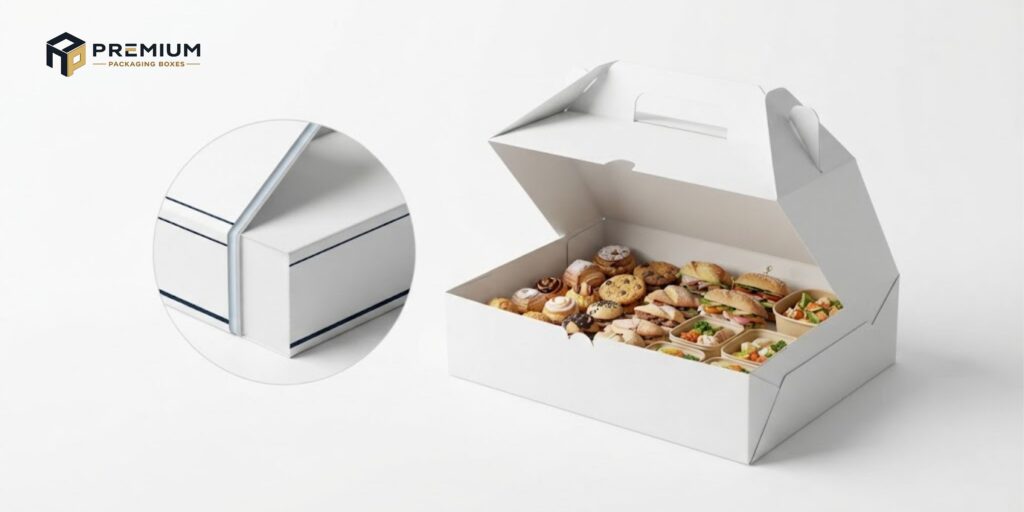







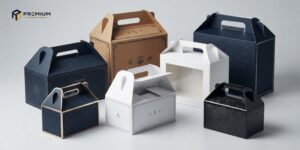

Are gable boxes food safe? They can be, provided the box is manufactured from materials and components suitable for the intended food-contact application. Food safety depends on more than the box shape itself. The paperboard, coatings, inks, adhesives, printing process, and intended food use all need to be considered.
For example, packaging designed for dry bakery products may have different requirements from packaging used for greasy, moist, hot, or chilled foods.
When selecting food-safe gable boxes, businesses should evaluate the complete packaging construction rather than relying only on terms such as “food grade” or “food safe.”
For broader applications, read our Gable Boxes for Food Packaging guide.
What Makes a Gable Box Food Safe?
A gable box becomes appropriate for a food application when its materials and construction are suitable for the specific way the package will be used.
Important factors include:
- Food-contact material suitability
- Paperboard composition
- Coatings and barriers
- Printing inks
- Adhesives
- Grease resistance
- Moisture resistance
- Temperature exposure
- Food type
- Contact duration
- Storage and transportation conditions
The same box structure may be suitable for one application but inappropriate for another if the material specification changes.
What Are Food-Grade Gable Boxes?
Food-grade gable boxes are packaging boxes manufactured using materials and components intended for the applicable food-packaging use.
The term “food grade” should not be treated as a universal guarantee for every food, temperature, or contact condition. Instead, the packaging specification should match the intended application.
For example, a bakery may require packaging suitable for:
- Cookies
- Donuts
- Pastries
- Cakes
- Brownies
- Bread
- Sweets
A restaurant may have different requirements for:
- Fried foods
- Burgers
- Sandwiches
- Saucy meals
- Hot takeaway foods
This is why product type and packaging construction should be evaluated together.
Materials Used in Food Gable Boxes
Material selection plays a central role in food packaging performance.
Kraft Paperboard
Kraft paperboard provides a natural appearance and can be used for selected food packaging applications when the material specification is appropriate.
It is particularly popular with:
- Bakeries
- Cafes
- Organic food brands
- Artisan food businesses
- Sustainable packaging programs
See our Kraft Gable Boxes for a dedicated product option.
White SBS Paperboard
SBS, or Solid Bleached Sulfate, offers a smooth white surface that works well for detailed printing and brand presentation.
It can be a strong option when a business needs:
- High-quality graphics
- Bright brand colors
- Clean product presentation
- Retail-ready packaging
Corrugated Board
Corrugated construction adds structural strength through its fluted internal layer.
It can be considered for heavier food products or applications where additional protection is required.
Recycled Paperboard
Recycled board can support packaging strategies focused on recycled content, subject to the requirements of the intended food-contact application.
Food Contact Packaging: Direct vs. Indirect Contact
One of the most important considerations is whether the food touches the packaging directly.
Direct Food Contact
Direct food contact means the food is placed directly against the packaging surface.
Examples may include:
- Cookies
- Bread
- Dry pastries
- Sweets
- Bakery products
For these applications, the material and any coatings or printing components contacting the food need to be suitable for the intended use.
Indirect Food Contact
Indirect contact occurs when another suitable layer separates the food from the box.
For example, food may be placed inside:
- A food-safe liner
- A sealed pouch
- A tray
- A wrapper
- An internal insert
This separation can change the packaging requirements, but the complete packaging system still needs to be evaluated.
Are Paper Gable Boxes Safe for Food?
Paperboard can be used for food packaging when the selected grade and construction are appropriate for the intended application.
However, untreated paperboard is not automatically suitable for every food.
Factors such as oil, water, steam, heat, and condensation can affect packaging performance.
That’s why paper gable boxes intended for food applications may require additional barrier properties depending on the product.
Grease-Resistant Coatings for Gable Boxes
Grease can penetrate paperboard and cause staining, weakening, or loss of structural integrity.
A suitable grease-resistant coating or barrier can help protect the packaging when it is exposed to oily foods.
This can be relevant for:
- Fried chicken
- French fries
- Burgers
- Donuts
- Pastries
- Oily snacks
- Fried foods
The required barrier should be selected according to the food and expected contact conditions.
Moisture Barriers for Food Packaging
Moisture is another major consideration.
Hot food can generate steam and condensation, while chilled products can expose packaging to moisture from refrigeration.
A suitable moisture barrier may help maintain the package’s structural performance.
When specifying packaging, consider:
- Food moisture
- Product temperature
- Holding time
- Refrigeration
- Condensation
- Transportation conditions
A moisture-resistant structure can be particularly useful for takeaway and food-delivery applications.
Are Food-Safe Inks Important?
Yes. Printing components should also be considered when packaging is intended for food use.
A printed box can contain several components, including:
- Inks
- Coatings
- Varnishes
- Adhesives
- Foils
For direct food-contact applications, the packaging specification should account for potential migration and the applicable requirements for the intended market.
Businesses should discuss the intended food application with their packaging supplier before finalizing materials and printing specifications.
For branding options, see Custom Printed Gable Boxes.
How Coatings Affect Food Packaging
Coatings can provide additional functional properties to paperboard packaging.
Depending on the packaging specification, coatings can help with:
- Grease resistance
- Moisture resistance
- Surface protection
- Print protection
- Appearance
- Durability
However, a coating should not automatically be described as food safe simply because it provides a barrier.
The complete coating system must be appropriate for the intended food-contact conditions.
Are Gable Boxes Safe for Hot Food?
They can be suitable for selected hot-food applications when the complete packaging specification is designed for the expected temperature and moisture conditions.
Hot food introduces additional considerations such as:
- Steam
- Condensation
- Heat transfer
- Grease
- Structural softening
- Holding time
For example, a box designed for dry bakery products may not provide the same performance when used for a hot, greasy meal.
For restaurant applications, see Gable Boxes for Restaurants & Takeout Food.
Are Gable Boxes Suitable for Bakery Products?
Yes, gable-style packaging can be useful for many bakery applications when the material and structure are appropriate.
Common applications include:
- Cookies
- Donuts
- Cupcakes
- Brownies
- Pastries
- Muffins
- Bread
- Dessert assortments
For larger or delicate products, structural design becomes particularly important.
Read Gable Cake Boxes for Bakeries for cake-specific packaging.
Food Safety Considerations for Different Foods
| Food Type | Key Packaging Considerations |
| Cookies | Dry-food suitability, product fit |
| Bread | Moisture, ventilation where appropriate |
| Donuts | Grease resistance, product clearance |
| Pastries | Grease and moisture considerations |
| Fried Foods | Grease resistance, steam and condensation |
| Burgers | Heat, moisture and grease |
| Cakes | Structural strength, product protection |
| Sweets | Food-contact material, product presentation |
| Chilled Foods | Moisture and temperature conditions |
The exact packaging specification should always be determined according to the actual product and intended conditions.
How to Choose Food-Safe Gable Boxes
1. Identify the Food
Determine whether your product is dry, greasy, moist, hot, chilled, or frozen.
2. Determine Contact Type
Establish whether food will directly contact the box or whether a liner or inner package will separate the food.
3. Select the Appropriate Material
Choose the appropriate paperboard, kraft, SBS, recycled board, or corrugated construction.
4. Evaluate Grease & Moisture
Determine whether your product requires a grease-resistant coating or moisture barrier.
5. Consider Temperature
Hot and chilled products can create different packaging requirements.
6. Confirm Printing Components
Discuss inks, coatings, adhesives, and other components with your packaging supplier for the intended application.
7. Test the Finished Package
Before ordering at scale, test the actual box with the actual food product under realistic conditions.
Food Safety vs. Packaging Performance
It’s important to separate food safety from structural performance.
A package may be made from an appropriate food-contact material but still fail operationally if:
- The box is too small
- The handle cannot support the contents
- Grease weakens the board
- Moisture causes deformation
- The bottom closure is insufficient
- The product shifts during transportation
That’s why food packaging should be evaluated as a complete system.
Common Mistakes When Choosing Food Gable Boxes
Assuming Every Paper Box Is Food Safe
Paperboard specifications vary considerably. Packaging should be selected for the intended application.
Ignoring Grease
Oily foods can quickly affect untreated paperboard.
Overlooking Condensation
Hot or chilled products may introduce moisture that affects the package.
Choosing the Wrong Size
An oversized box can allow food to move, while an undersized box can damage the product.
Focusing Only on Printing
Brand presentation matters, but the structural and functional requirements should come first.
Skipping Testing
Testing the actual package with the intended food can reveal issues before bulk production.
Frequently Asked Questions
Can you put food directly in a gable box?
It depends on the material, coating, construction, and intended food-contact application. The box should be specifically suitable for direct food contact where food touches the packaging.
Are kraft gable boxes food safe?
Kraft gable boxes can be suitable for certain food applications when the selected material and complete packaging construction meet the requirements of that application.
Do food gable boxes need a coating?
Not necessarily. The requirement depends on the food product and whether grease, moisture, or other barriers are needed.
Are gable boxes suitable for greasy food?
They can be, provided the box has an appropriate grease-resistant construction for the intended application.
Can gable boxes hold hot food?
Selected gable boxes can be designed for hot-food applications, but temperature, steam, grease, moisture, and holding time should be considered before selecting the packaging.
Are printed gable boxes safe for food?
They can be when the printing inks, coatings, adhesives, board, and complete construction are appropriate for the intended food-packaging application.
Final Takeaway
Food-safe gable boxes are not defined by their shape alone. Their suitability depends on the complete packaging system, including the paperboard, coatings, inks, adhesives, grease resistance, moisture protection, temperature conditions, and type of food contact.
For businesses choosing packaging for bakery products, takeaway meals, sweets, catering, or restaurant orders, matching the box specification to the actual food application is the safest approach.