

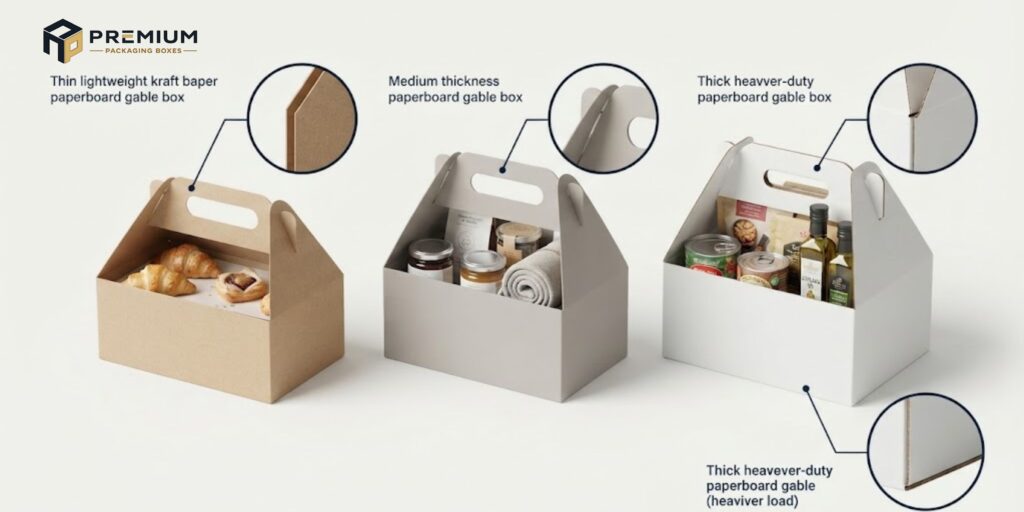












Choosing the right gable box thickness is essential for creating packaging that can hold the product securely, support the built-in handle, maintain its shape, and withstand normal handling. Thickness should not be selected by appearance alone. Gable box GSM, board weight, product weight, box dimensions, material type, and structural design all work together to determine the final performance of the package.
A lightweight favor box may need a very different paperboard specification than a large food container, retail package, or corporate gift box. The goal is to select enough material strength for the application without unnecessarily increasing packaging weight or cost.
What Is Gable Box Thickness?
Gable box thickness refers to the thickness and structural specification of the paperboard or cardboard used to manufacture the box.
It can be described using several measurements, including:
- GSM (grams per square meter)
- PT (point thickness)
- Board caliper
- Material weight
- Board grade
- Flute profile for corrugated construction
These measurements are related, but they do not mean exactly the same thing.
For a broader understanding of available materials, start with Best Materials for Gable Boxes: Kraft, SBS, Paperboard & Corrugated Compared.
Why Does Gable Box Thickness Matter?
The board specification influences how the finished package performs during assembly, carrying, storage, and transportation.
The right specification can help provide:
- Structural strength
- Better shape retention
- Handle support
- Bottom stability
- Improved stacking performance
- Better product protection
- More consistent folding
- A higher-quality feel
However, thicker does not automatically mean better.
A very thick board can make folding more difficult, increase material usage, affect the box’s appearance, and add unnecessary cost. The correct specification should match the product and structural requirements.
GSM vs. PT: What’s the Difference?
Two common terms you may encounter when discussing paperboard are GSM and PT.
What Is GSM?
GSM means grams per square meter. It measures the weight of paper or paperboard over a standardized area.
A higher GSM generally indicates a heavier board, but GSM alone does not provide a complete measurement of physical thickness or strength.
Different paperboard grades can have different densities, meaning two boards with similar GSM values may not perform identically.
What Is PT?
PT refers to point thickness, a measurement of material caliper.
One point represents one-thousandth of an inch.
Therefore, PT is directly related to the physical thickness of the board, while GSM measures its weight per unit area.
GSM vs. PT
| Measurement | What It Measures | Why It Matters |
| GSM | Board weight per square meter | Helps identify material weight |
| PT | Physical board thickness | Helps evaluate caliper |
| Caliper | Material thickness | Important for folding and structure |
| Board grade | Material composition/specification | Influences overall performance |
When comparing suppliers, it is better to ask for the complete board specification rather than relying on GSM alone.
What Determines the Right Gable Box Thickness?
Several factors should be considered before choosing the board.
1. Product Weight
Product weight is one of the most important factors.
A small box containing lightweight sweets does not place the same load on its handle and bottom as a large box carrying multiple retail products.
Heavier products may require:
- Higher board weight
- Greater caliper
- Stronger bottom construction
- Reinforced handle areas
- More robust structural engineering
2. Box Dimensions
Box size affects structural performance.
As the box becomes larger, the panels have more surface area and may experience greater bending or deformation during handling.
A large box therefore may require a different material specification from a small box even when both contain relatively similar products.
3. Handle Load
The built-in handle is particularly important for gable packaging.
When a customer lifts the package, the handle transfers the load into the upper panels and surrounding structure.
The handle specification should therefore account for:
- Product weight
- Handle opening size
- Panel dimensions
- Material thickness
- Reinforcement
- Die-cut geometry
For more information about this packaging feature, see Gable Boxes With Handles: Easy-Carry Packaging for Businesses.
4. Bottom Construction
The bottom of the box must support the product while the package is being carried.
An appropriate bottom structure can help prevent:
- Opening
- Sagging
- Product displacement
- Panel deformation
The board specification and bottom construction should be designed together.
5. Transportation Conditions
Packaging that remains on a retail shelf has different requirements from packaging that travels through delivery networks.
Consider whether the box will experience:
- Local customer carrying
- Courier delivery
- E-commerce shipping
- Stacking
- Warehouse storage
- Repeated handling
Longer transportation routes and heavier handling conditions may require additional structural consideration.
Gable Box Thickness by Product Type
There is no single thickness suitable for every product. A practical starting point is to classify packaging by application.
| Product / Application | Typical Material Consideration | Main Structural Concern |
| Small favors | Lightweight paperboard | Shape retention |
| Sweets & samples | Light-to-medium board | Product protection |
| Bakery products | Food-suitable paperboard | Grease/moisture + structure |
| Takeaway food | Medium board or suitable construction | Weight + moisture |
| Retail products | Medium paperboard | Shelf presentation + durability |
| Gift sets | Medium-to-heavy board | Product weight + presentation |
| Corporate kits | Medium/heavy board | Multiple-item load |
| Large products | Heavy paperboard/corrugated | Load capacity |
These are application categories, not universal GSM or PT specifications. The final board should be selected after evaluating the actual product and box dimensions.
How to Choose Gable Box GSM
When selecting gable box GSM, avoid choosing a specification simply because it has a higher number.
Instead, evaluate the complete packaging structure.
Lightweight Applications
For small, lightweight products, a lighter paperboard can often provide sufficient rigidity while keeping the package easy to fold and carry.
Potential applications include:
- Small favors
- Samples
- Lightweight sweets
- Small promotional items
Medium-Weight Applications
Medium-weight products may require a more substantial paperboard specification to maintain shape and handle performance.
Potential applications include:
- Bakery products
- Retail products
- Takeaway packaging
- Gift boxes
Heavy Applications
Heavier products may require stronger board construction, reinforced structures, or corrugated material depending on the dimensions and handling requirements.
Potential applications include:
- Large gift sets
- Multiple-product packages
- Heavy retail items
- Corporate promotional kits
The correct GSM should be determined by the supplier or packaging engineer after reviewing the product specifications.
How Product Weight Affects Load Capacity
Load capacity refers to the amount of weight the finished packaging structure can safely support under its intended handling conditions.
It is important to understand that load capacity cannot be calculated from GSM or PT alone.
It depends on:
- Board grade
- Material thickness
- Box dimensions
- Handle design
- Bottom structure
- Die-cut geometry
- Fold lines
- Adhesive points
- Product weight distribution
- Carrying conditions
For example, a box with a strong board can still perform poorly if its handle or bottom structure is not designed for the intended load.
Gable Box Thickness and Structural Strength
Structural strength is the result of the entire package design rather than the board thickness alone.
A well-engineered gable box considers:
Panel Strength
Large panels need enough rigidity to prevent excessive bending.
Handle Strength
The handle area must transfer the product load without tearing or deforming.
Bottom Strength
The base must support the contents without opening or collapsing.
Fold Strength
The board needs to fold cleanly along the intended score lines.
Closure Strength
The locking mechanism should remain secure during normal carrying and handling.
This is why structural design should happen before final material selection.
Does a Thicker Gable Box Always Mean a Stronger Box?
No.
A thicker board can provide additional rigidity, but overall package performance depends on the interaction between material and design.
A well-designed box using an appropriately specified board can outperform a poorly designed box made from a thicker material.
Important variables include:
- Material density
- Fiber composition
- Board construction
- Die-cut pattern
- Score placement
- Handle design
- Bottom construction
- Adhesive
- Box dimensions
Therefore, thickness should be optimized rather than maximized.
Choosing Thickness for Food Gable Boxes
Food packaging introduces additional considerations beyond structural strength.
The material may need to withstand:
- Grease
- Oil
- Moisture
- Condensation
- Heat
- Refrigeration
- Food contact
For suitable applications, food-grade board and appropriate coatings or barriers may be required.
Food Gable Boxes can be specified according to the type of food product and expected handling conditions.
For related guidance, read Are Gable Boxes Food Safe? Materials, Coatings & Packaging Considerations.
Choosing Thickness for Bakery Gable Boxes
Bakery products often need a balance between rigidity and presentation.
Cookies and lightweight pastries may have different requirements from:
- Cake slices
- Dessert assortments
- Donuts
- Heavier pastry boxes
- Larger bakery gift sets
The box should provide sufficient structure without unnecessarily increasing material weight.
For cake-specific packaging, see Gable Cake Boxes.
Thickness for Kraft Gable Boxes
Kraft board is available in different weights and specifications, so the term “kraft” alone does not identify the strength of a finished box.
When selecting kraft packaging, consider:
- GSM
- Caliper
- Fiber composition
- Box dimensions
- Product weight
- Handle design
- Bottom construction
- Moisture exposure
For the visual and material differences between kraft and white board, see Kraft Gable Boxes vs. White Gable Boxes.
Thickness for Large Gable Boxes
Large boxes require particular attention because increased dimensions can change the structural behavior of the package.
For large formats, evaluate:
- Product weight
- Panel size
- Handle position
- Bottom design
- Board rigidity
- Stacking conditions
- Transportation requirements
If a large box will carry multiple products, the combined weight should be considered rather than the weight of an individual item.
Does Box Thickness Affect Printing?
It can.
Board selection affects the overall printing and finishing process because different materials have different surface characteristics and folding behavior.
Before selecting a board, consider the desired:
- CMYK printing
- PMS color matching
- Digital printing
- Offset printing
- Foil stamping
- Embossing
- Debossing
- UV finishing
- Matte or gloss coating
For branding-focused packaging, see Custom Printed Gable Boxes.
Thickness and Gable Box Cost
Material thickness can influence packaging cost because heavier or more specialized board may require more material and affect manufacturing requirements.
However, thickness is only one part of the total cost.
Other cost factors include:
- Box dimensions
- Material grade
- Order quantity
- Printing method
- Number of colors
- Finishing
- Window installation
- Structural complexity
- Shipping requirements
For businesses ordering at scale, Gable Boxes in Bulk can provide different pricing based on quantity and specifications.
How to Choose the Right Thickness: Step-by-Step
Step 1: Identify the Product
Determine exactly what will be packaged.
Step 2: Measure the Product
Record length, width, and height.
Step 3: Calculate the Approximate Product Weight
Include the combined weight when multiple items will be packed together.
Step 4: Define the Carrying Conditions
Determine whether customers will carry the box short distances or whether it will be shipped through a delivery network.
Step 5: Select the Material
Choose kraft, white paperboard, SBS, corrugated cardboard, recycled board, or another suitable substrate.
Step 6: Determine the Board Specification
Evaluate GSM, PT/caliper, and board grade based on the complete structural design.
Step 7: Check the Handle and Bottom
Make sure the handle and base are engineered for the expected load.
Step 8: Test the Structure
A physical sample can help evaluate:
- Handle performance
- Bottom strength
- Product fit
- Folding
- Closure
- Overall appearance
Step 9: Approve the Final Specification
Once the dimensions, material, thickness, printing, and structural design have been confirmed, the packaging can proceed to production.
Common Mistakes When Choosing Gable Box Thickness
Choosing the Highest GSM Available
More material is not always necessary.
Looking Only at GSM
GSM does not fully describe board thickness or structural performance.
Ignoring Product Weight
The handle and bottom must support the actual packaged load.
Ignoring Box Dimensions
Larger panels can require different structural considerations.
Selecting Thickness Before Designing the Structure
Material and structural engineering should be developed together.
Forgetting Food-Contact Requirements
Food packaging may require specific materials, coatings, or barriers.
Skipping a Structural Test
A prototype or sample can identify problems before a large production run.
Gable Box Thickness vs. Application
| Requirement | What to Prioritize |
| Lightweight favor | Folding + shape retention |
| Bakery packaging | Food suitability + grease/moisture resistance |
| Takeaway packaging | Strength + moisture resistance |
| Retail packaging | Rigidity + print surface |
| Gift packaging | Rigidity + presentation |
| Heavy product | Load capacity + handle strength |
| Large box | Panel rigidity + bottom strength |
| E-commerce | Compression + transportation performance |
| Eco-focused packaging | Suitable board + material efficiency |
Frequently Asked Questions
What is the best GSM for gable boxes?
There is no universal best GSM. The appropriate specification depends on the product weight, box dimensions, material grade, handle design, bottom structure, and intended use.
What does GSM mean in packaging?
GSM means grams per square meter. It measures the weight of paper or paperboard over a standardized area. It should not be treated as a direct measurement of structural strength.
What does PT mean for paperboard?
PT refers to point thickness, which measures the physical caliper of the board. One point equals one-thousandth of an inch.
Is higher GSM always stronger?
No. Board strength depends on material composition, density, construction, thickness, and the overall box design.
What thickness is best for food gable boxes?
The appropriate specification depends on the food product, box dimensions, product weight, grease and moisture exposure, and applicable food-contact requirements.
Does a large gable box need thicker board?
Not automatically, but larger dimensions and heavier loads can increase structural demands. The final specification should be determined from the complete package design.
How can I determine the load capacity of a gable box?
Load capacity should be evaluated using the material specification, dimensions, handle structure, bottom construction, and intended carrying conditions. For important applications, structural testing is recommended.
Can I customize the thickness of my gable boxes?
Yes. Custom packaging can be specified according to product weight, dimensions, application, material, and structural requirements.
Final Thoughts
The right gable box thickness is a balance between material weight, physical caliper, product weight, dimensions, handle construction, bottom strength, and intended use. Gable box GSM can help identify board weight, while PT or caliper helps describe physical thickness, but neither measurement should be used alone to determine performance.
For lightweight products, an appropriately specified paperboard may provide sufficient rigidity. Larger, heavier, or transportation-intensive applications may require stronger board construction or corrugated materials.
The best approach is to design the box around the product first, then select the material and thickness needed to support that structure.
If you need packaging designed around your exact product dimensions and load requirements, see Custom Gable Boxes.